

Dust explosions in silos pose a serious threat to the safety and economy of industrial plants. According to statistics, European industry records an average of one dust-air explosion every day, and about 14% of these incidents occur in silos. One of the key contributors is grain dust explosion, caused by the accumulation of combustible dust in a confined space.
Below we examine the factors that lead to combustible dust explosions and the measures required to prevent such incidents.
What Are Silos and Where They Are Used
Silos are tall cylindrical or rectangular structures designed for storing bulk materials in large volumes. They play a critical role in industrial logistics, enabling accumulation, temporary storage, and controlled discharge of materials such as sugar, grain, cement, coal, plastic pellets, and other bulk products.
Virtually all industries use bulk materials that are stored in silos or bunkers.
| Industry sector | Type of stored material |
|---|---|
| Agrarian | Wheat, corn, barley, soybeans, sunflowers |
| Food | Sugar, flour, starch, milk powder |
| Mining | Coal, ore, crushed stone |
| Chemical | Mineral fertilizers, polymers |
| Energy | Wood chips, pellets |
The accumulation of combustible dust in silos creates a serious hazard: high dust concentration in a confined space can easily ignite and result in a powerful explosion.
Why Does Dust in Silos Explode?
Combustible dust consists of fine particles that, under certain conditions, can ignite and rapidly propagate combustion in air. The danger lies in the ability of dust to form explosive dust-air mixtures.
A dust explosion can occur only when all elements of the dust explosion pentagon are present:
- Presence of a combustible substance (dust) in a concentration between the lower and upper flammability limits
- Dust dispersion in air with sufficient particle fineness
- Presence of an oxidizer (oxygen)
- Presence of an ignition source
- Confinement
Typical ignition sources include open flames, electrical sparks, mechanical friction, hot surfaces, static electricity, and exothermic reactions.
If at least one of these elements is absent, a dust explosion cannot occur.
Factors Contributing to Dust Accumulation
Dust particles are lightweight and can easily disperse through air. Over time, even small deposits can accumulate to dangerous levels due to several factors:
- Gradual accumulation that remains unnoticed
- Dust deposits in hidden or hard-to-reach areas
- Insufficient or improper housekeeping
- Underestimation of dust explosion risks by personnel
Dust commonly accumulates on equipment surfaces, beams, floor slabs, ventilation ducts, and in underfloor spaces.
Main Consequences of Silo Explosions
Dust explosions in silos pose a direct threat to personnel safety and cause significant damage to equipment and production processes.
Human Casualties and Injuries
Blast waves and flying debris can cause severe injuries or fatalities. Victims may suffer burns, fractures, contusions, and other trauma requiring long-term treatment.
Destruction of Equipment and Infrastructure
Explosion overpressure can collapse silos and destroy buildings and process equipment. This may result in material spills and environmental contamination.
Economic Losses
Enterprises may face high repair costs, prolonged downtime, compensation payments, regulatory penalties, and reputational damage. In severe cases, explosions can lead to bankruptcy.
Incident Examples
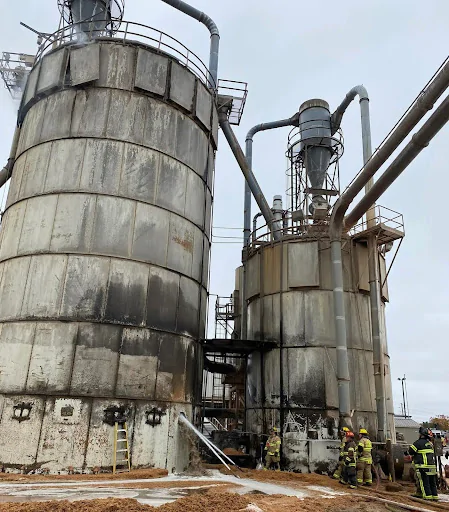
2022 – Tennessee, USA (Crossville Hardwoods):
A dust explosion occurred during firefighting operations in a sawdust bunker. A spark near the bottom of the bin ignited wood dust, tearing off the top of the bunker.
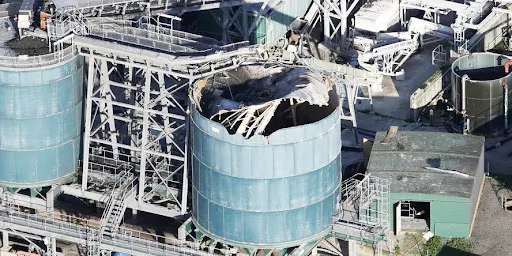
2020 – Essex, UK (Tilbury docks):
A large grain dust explosion occurred in a grain store, with flames reaching approximately 75 m. Several silos were destroyed, and firefighting operations lasted 20 days. One person was hospitalized with carbon monoxide poisoning.
2023 – Derince, Turkey (local port):
A grain dust explosion occurred during silo loading. Thirteen silos were damaged, grain losses reached 10–15 thousand tons, nearby buildings were damaged, and 12 people were injured.
Measures to Prevent Grain Dust Explosions
Preventing grain dust explosions requires a comprehensive approach combining organizational measures and technical explosion protection solutions.
Technical Solutions
- Industrial dust collection and extraction systems
- Control of material humidity to reduce dust formation
- Spark detection and extinguishing systems
- Grounding and bonding of process equipment
Explosion Protection Systems
Explosion protection systems are designed to suppress, vent, or isolate explosions in order to minimize damage and prevent propagation.
- Explosion suppression (HRD system)
Active explosion protection based on early detection and rapid injection of an explosion suppressant into the protected volume. - Explosion venting
Passive explosion protection using explosion venting devices, including explosion venting panels and FLEX flameless explosion venting devices, to safely relieve overpressure. - Explosion isolation
Use of isolation devices such as B-FLAP check valves, GATEX gate valves, and HRD barriers to prevent flame and pressure propagation.
Organizational Measures
- Regular training and briefing of personnel
- Periodic explosion risk audits and inspections
- Systematic housekeeping to remove settled dust
Conclusion
Dust explosions are a predictable and controllable industrial hazard. Effective prevention requires controlling dust generation, eliminating ignition sources, and applying appropriate explosion protection systems.
A critical element of industrial safety management is auditing for combustible dust presence and accumulation, followed by laboratory dust testing. Based on audit and test results, optimal explosion protection solutions can be selected.
Implementing these measures significantly reduces dust explosion risks and ensures a safer working environment.